Filters
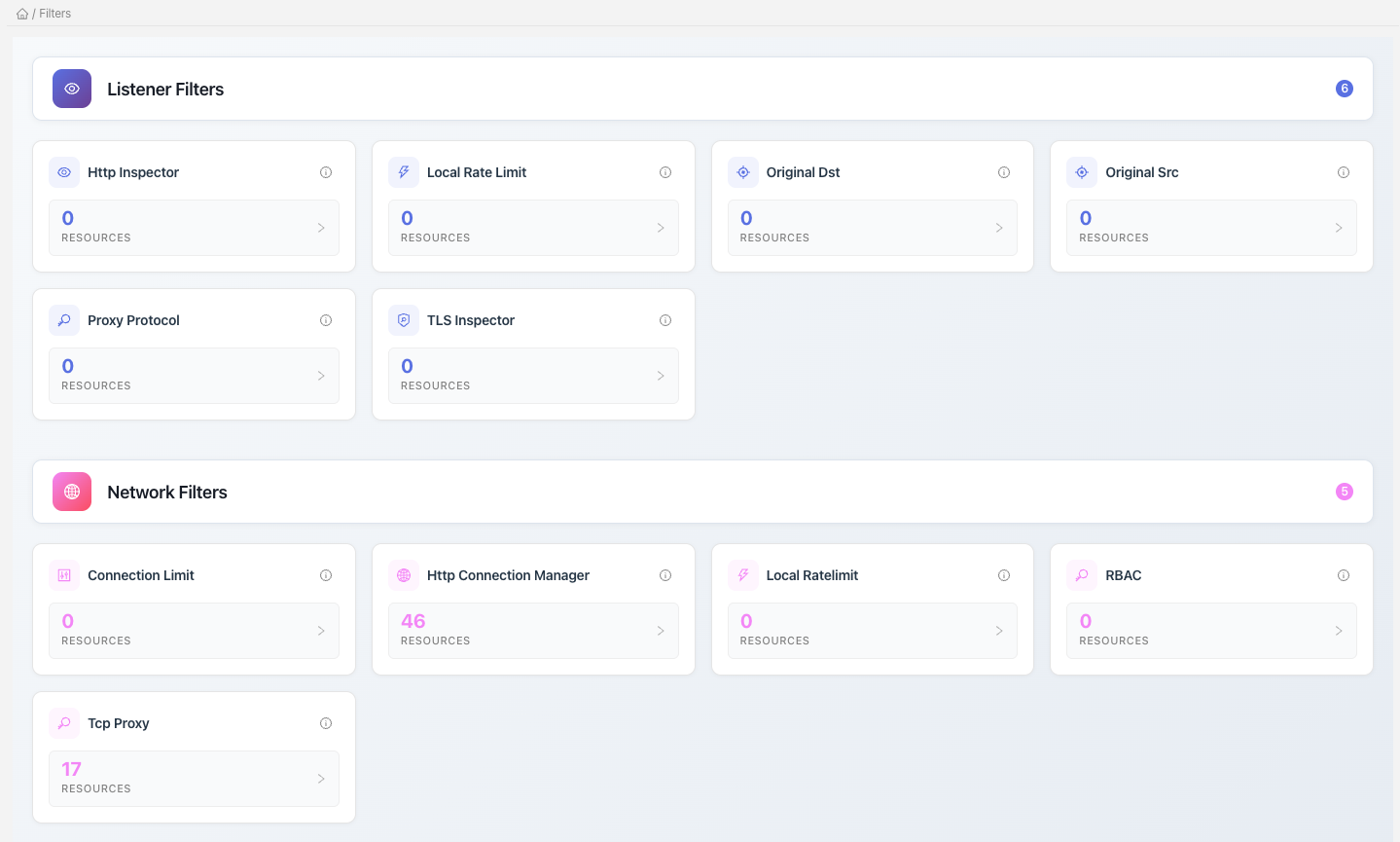
Filters are the pluggable units of Envoy's data path. A connection or request flows through an ordered chain of filters, each doing one job — inspect TLS, terminate HTTP, authenticate, rate-limit, mutate headers, proxy to an upstream. Envoy groups filters by where they run, and Elchi exposes the same four categories:
| Category | Runs on | Examples |
|---|---|---|
| Listener filters | A Listener, before a filter chain is chosen | TLS Inspector, HTTP Inspector, Original Dst/Src, Proxy Protocol |
| Network filters | A listener filter chain (L4) | HTTP Connection Manager, TCP Proxy, RBAC, Local Rate Limit, Redis/Mongo Proxy, SNI Cluster |
| HTTP filters | Inside the HTTP Connection Manager (L7) | Router, JWT Auth, Ext Authz, External Processor (ext_proc), CORS, RBAC, Local Rate Limit, Lua, WASM, Compressor |
| UDP filters | A UDP listener | DNS Filter, UDP Proxy |
The single most important network filter is the HTTP Connection Manager (HCM) — it turns a TCP connection into HTTP and hosts the ordered HTTP filter chain. The Router is the terminal HTTP filter that actually dispatches to a cluster; every HTTP filter chain ends with it.
In Elchi
Filters live under Filters in the UI, grouped by the four categories above (/filters/listener/..., /filters/network/..., /filters/http/..., /filters/udp/...). Each filter type has its own list and create flow; as with every resource you choose an Envoy version first and get a form generated from that version's protobuf.
You author a filter as a reusable, named resource, then attach it by reference where it belongs — listener filters and network filters onto a listener/filter chain, HTTP filters into an HCM's http_filters list. HTTP filters can also be overridden per route or per virtual host via typed_per_filter_config.
Within the HCM, HTTP filters run in the order listed, and the Router must be last. Put authentication and security filters (JWT, ext_authz, WAF, ext_proc) ahead of the Router so they can reject a request before it reaches an upstream.
Where WAF and Shield fit
Two Elchi security features are delivered as HTTP filters in the HCM chain:
- WAF (Coraza / OWASP CRS) — delivered as an HTTP WASM filter. On an HCM you set the WAF config by name, and Elchi injects the corresponding WASM filter into the chain. See WAF.
- Elchi Shield (API security) — a local ext_proc sidecar reached through an Envoy External Processor (ext_proc) HTTP filter. Toggling API Security on an HCM prepends the
elchi-shieldext_proc filter so it runs first in the chain, ahead of routing. See Shield: Envoy wiring.
Both are ordinary HTTP filters from Envoy's perspective — the difference is that Elchi manages their injection and keeps the filter list consistent for you.
Key fields
Filter configuration is entirely per-type, but the shape is uniform: a name plus a typed_config (the Envoy @type and its fields). Elchi's generated form drives the typed_config for each filter, so you edit real Envoy fields rather than raw JSON.
| Concept | Purpose |
|---|---|
name | The filter instance name within its chain. |
typed_config | The filter's Envoy message (its @type decides which fields apply). |
| Per-route override | typed_per_filter_config on a route/vhost to enable, disable, or retune an HTTP filter. |
Relationships
- Attached to listeners — listener and network filters build a Listener's chains; the HCM is the network filter that hosts HTTP filters.
- Reference route configs — the HCM points at a Route Configuration (inline or RDS).
- Reference clusters/secrets — filters like ext_authz, ext_proc, OAuth2, and JWT reach out to a Cluster or use Secrets.
- Complex typed configs live as Extensions — some filters reference shared, separately-managed extension configs (e.g. access loggers, compressor libraries).
Example
An HCM HTTP filter chain with security ahead of the Router:
http_filters:
  - name: elchi-shield            # ext_proc — API security, runs first
    config_discovery: { config_source: { ads: {} } }
  - name: envoy.filters.http.jwt_authn
  - name: envoy.filters.http.cors
  - name: envoy.filters.http.router   # terminal filter — must be last
Tips
- The Router is always last. Anything after it never runs.
- Order security before routing. JWT/ext_authz/WAF/ext_proc must precede the Router to gate requests.
- Attach the right listener filters. SNI-based chain matching needs the TLS Inspector; protocol detection needs the HTTP Inspector.
- Use per-route overrides sparingly but deliberately to exempt health checks or internal paths from auth/rate-limiting.
- Let Elchi manage WAF/Shield injection rather than hand-editing the filter list — the toggles keep positions and references consistent.